If your team has a big enterprise pitch on Friday, rehearse in four time-boxed phases rather than one long run-through. Early in the week, run one full dress rehearsal with a colleague playing the toughest person on the buying committee, and give every section an owner and a hard time limit. The day before, stop rehearsing the whole pitch and drill only the three moments most likely to go wrong: the opening two minutes, the pricing question and the hand-offs between speakers. Sixty minutes before, do one timed run of the opening and confirm who answers which objection — then change nothing. In the final five minutes, say your first sentence out loud once, check the tech, and breathe. Most pitch teams over-rehearse content and under-rehearse transitions and pressure moments; the countdown below reverses that order, with a checklist for each phase.
A pitch team rarely loses an enterprise deal because a slide was wrong. It loses because the opening ran long, two people answered the pricing question differently, or a hand-off turned into an awkward pause in front of the CFO. Those are rehearsable moments, and they are exactly the ones a single run-through on Thursday night does not fix.
The countdown at a glance
| Phase | When | What to rehearse | Done when |
|---|---|---|---|
| 1. Dress rehearsal | The week before (Mon–Tue for a Friday pitch) | The whole pitch, timed, against a hostile buyer panel | Every section has one owner and a time limit the team has hit once |
| 2. Moment drills | The day before | Opening 2 minutes, pricing answer, speaker hand-offs, top five objections | Each moment has been repeated at least three times without notes |
| 3. Warm-up | 60 minutes before | One timed run of the opening; who-answers-what check | Nobody is editing slides |
| 4. Settle | 5 minutes before | First sentence out loud once; tech check; breathing | The lead speaker knows their first line cold |
The week before: one full dress rehearsal
Book 90 minutes, early enough that the team can still change the structure afterwards. Run the full pitch once, timed, without stopping — even when it goes badly. The point is to find where it breaks, not to polish it.
- Cast the room, not a friendly audience. Ask colleagues to play the specific people on the buying committee: the economic buyer, procurement, IT security, the sceptical end user. Brief each one with the question that person is most likely to ask.
- Time every section. Write the planned and actual minutes next to each section. Anything more than 20% over is a section to cut, not a section to rush.
- Assign one owner per section and per objection. Two people answering the same question is the most visible failure in a team pitch.
- Record it. Watch the opening and the pricing section back as a team. You will see pace, filler words and posture you did not feel in the room.
The day before: drill three moments, not the whole pitch
Running the full pitch again the day before mostly rehearses the parts that already work. Spend the time on the moments that decide how the buyer feels about the team.
- The opening two minutes. The lead speaker delivers it three times in a row, standing, without notes. The first 30 seconds should say why the team is there and what the buyer will get from the meeting.
- The pricing question. One person owns it. They answer it in under 30 seconds, three times, with someone interrupting with “that’s more than we budgeted”. Composure here is visible to every person in the room.
- The hand-offs. Script the exact sentence each speaker uses to pass to the next (“Priya will show you how that works in your environment”). Rehearse the transitions on their own, back to back.
- The top five objections. List them, name an owner for each, and run each answer once against the hostile-buyer colleague.
Set a stop time. No new slides after mid-afternoon: late changes create new transitions nobody has rehearsed. For the structure of each drill, use the 45-minute rehearsal session template and cut it to one scenario per drill.
60 minutes before: warm up, don’t rework
- Run the opening once, timed. Do not run the whole pitch.
- Say out loud who answers pricing, security and implementation questions.
- Check the demo environment, screen share, clicker, and a backup copy of the deck on a second laptop.
- Close the deck file. Editing slides now means someone presents a slide they have never seen.
The 5 minutes before
- The lead speaker says the first sentence out loud once.
- Slow your breathing: a longer exhale than inhale for a minute settles pace and voice.
- Phones on silent and face down; notifications off on the presenting laptop.
- Decide who you will make eye contact with first when you start speaking.
If you only have one day
Skip the full dress rehearsal. Run the opening, the pricing answer and the hand-offs three times each, assign objection owners, and do the 60-minute warm-up. Moment drills are what change on-the-day behaviour; a single full run-through mostly produces discussion.
How to tell the rehearsal worked
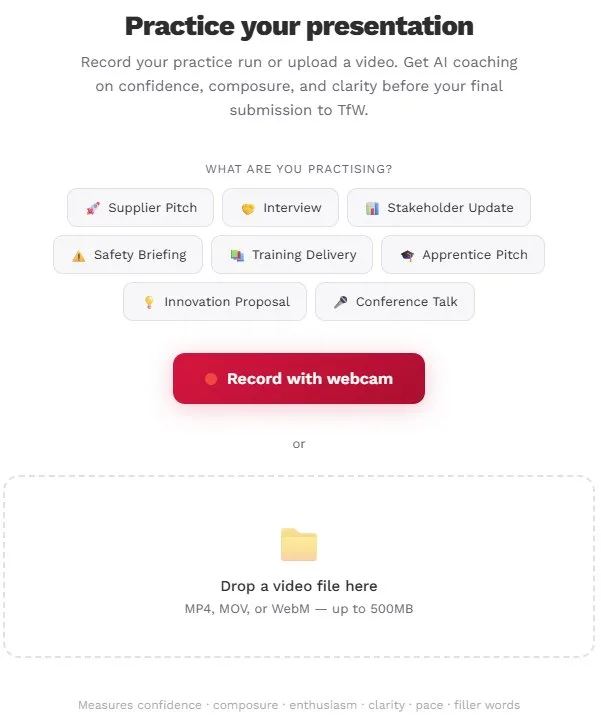
Before the pitch, you should be able to check five things: the opening lands inside its time; every hand-off has a named sentence; the pricing answer is under 30 seconds and consistent; each likely objection has one owner; and nobody reads from the slides. If you rehearse with an AI buyer, look at composure and confidence at the pricing moment rather than an overall score — that is the moment the buyer is watching most closely. See sales rehearsal metrics for what to score.